Aegis Geophysics
Insight from airborne, ground and downhole electromagnetic survey data for minerals and groundwater exploration
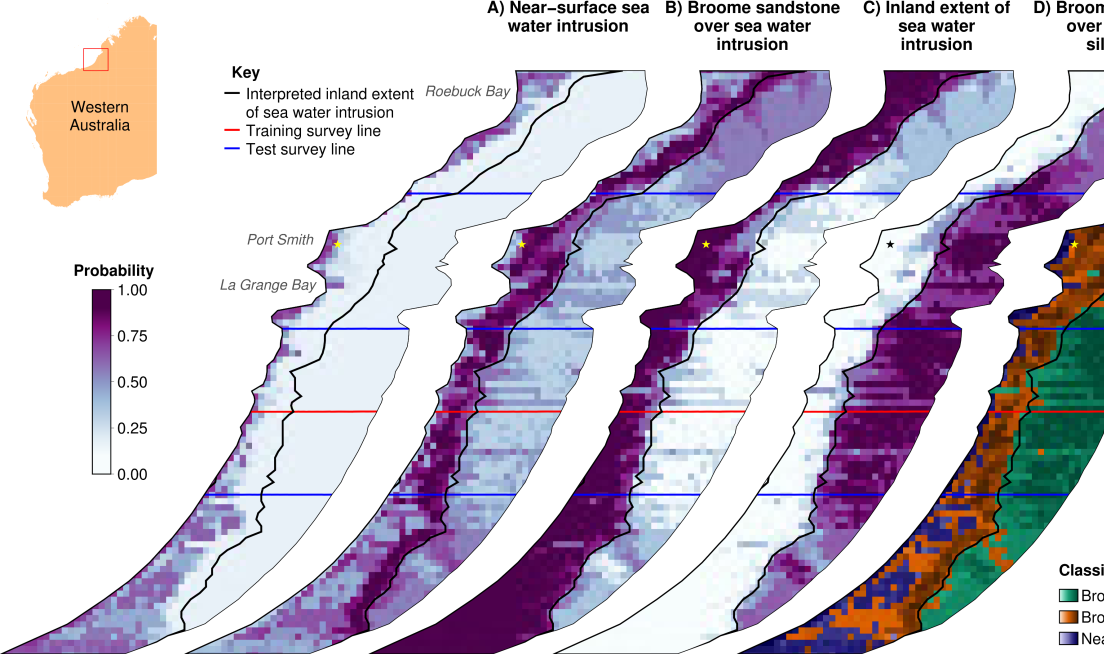
Aegis Geophysics is a consultancy specialising in forward and inverse modelling of airborne, ground and downhole electromagnetic survey data for minerals and groundwater exploration.
Forward modelling is an effective means to aid understanding of the interaction of a survey system with a target.
Inverse modelling is a useful lense through which to interpret field data.
Aegis Geophysics offers expert instruction in the use of the P223 codes. However, we prefer to use and develop more modern alternatives.
Aegis Geophysics is owned by Dr David Annetts.
GEMSModels: Modernisation of the P223 codes
The P223 suite of electromagnetic modelling codes, developed by CSIRO with industry support through a series of AMIRA projects, has been a trusted foundation for EM modelling since its release in 2008.
Today, many companies still use these tools but their legacy design makes them increasingly difficult to maintain, adapt, and extend to meet evolving project requirements. That can slow down interpretation, increase risk, and complicate integration with modern workflows.
Aegis Geophysics is addressing this with Geophysical Electromagnetic Survey Models (GEMSModels), a next‑generation modelling framework designed from first principles to support modern exploration and resource‑evaluation programmes. GEMSModels is a strategic rewrite designed to deliver better performance, greater flexibility, and long‑term sustainability.
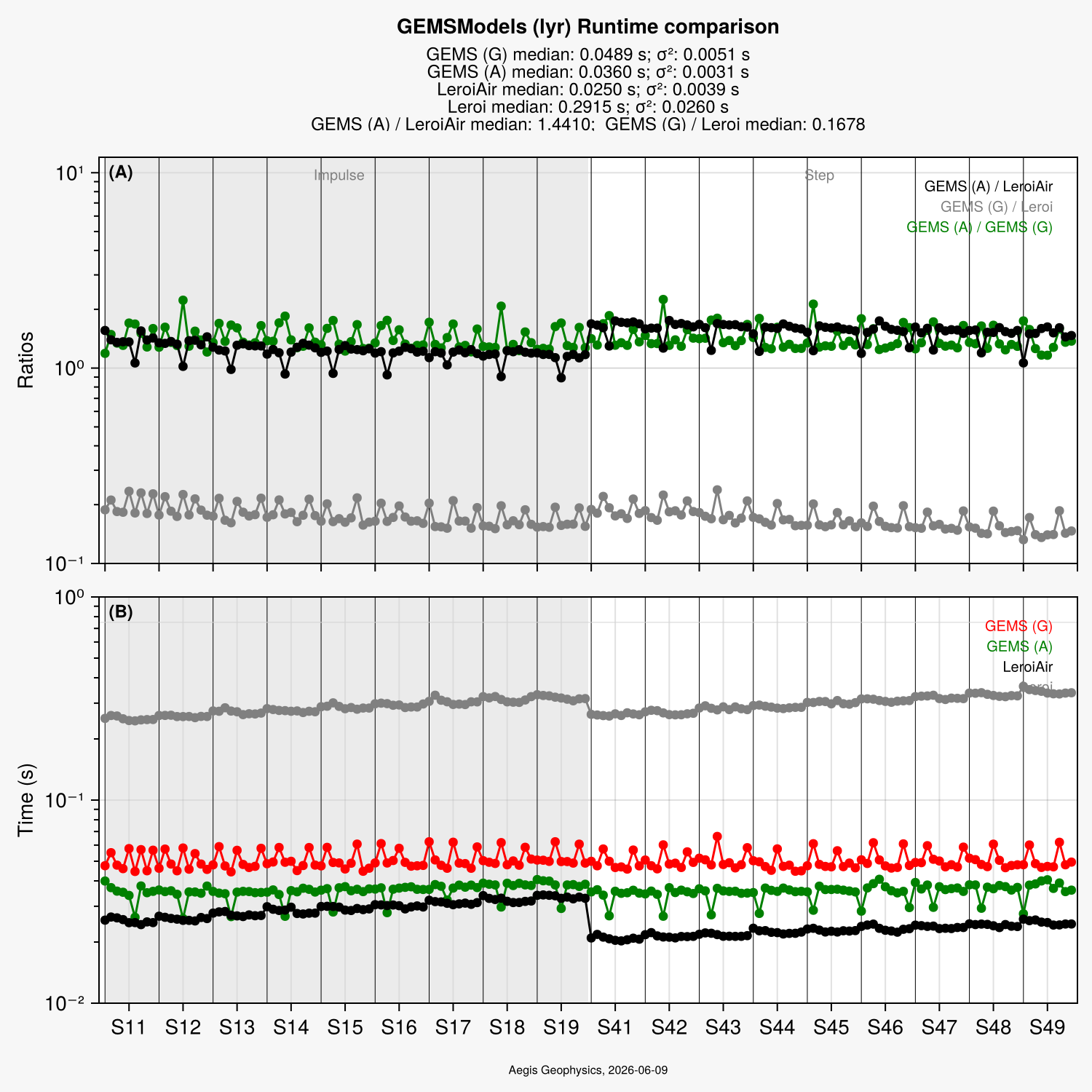
The first component of the modernised suite, lyr, already delivers clear performance gains. With a median run time under 0.05 s, lyr is about six times faster than Leroi. In addition to the advantages for ground surveys, this allows the use of a more accurate, general algorithm for airborne problems, with a fallback to a less accurate but faster algorithm if required. Developed in Julia with a focus on structured maintainable code, it offers strong performance, compared to legacy workflows, while preserving the maintainability needed for long-term development. For your projects, that means quicker turnaround on forward modelling, access to more general and accurate algorithms, faster iteration during survey design, and more reliable results for decision-making.
Aegis Geophysics is developing GEMSModels as part of its consulting offering, specifically to help companies streamline EM modelling, reduce uncertainty, and accelerate exploration workflows.
If you would like to discuss how this capability can support your current or planned projects, please contact Aegis Geophysics.
Selected conference presentations
Year | Title | Conference |
2026 | ASEG 2026, Cairns | |
2021 | AEGC, Brisbane | |
2019 | AEGC, Perth | |
2018 | AEGC, Sydney | |
2016 | ASEG-PESA, Adelaide | |
2015 | The application of AEM to mapping sea-water intrusion at La Grange, WA | ASEG-PESA, Perth |
2013 | Effects of the choice of transient sampling scheme on AEM-derived electrical conductivity models | IAH Congress, Perth |
2013 | AEM Workshop, Kruger National Park, South Africa | |
2004 | The time-domain electromagnetic response of wedge-like structures | ASEG, Sydney |
2003 | Modelling and matching the airborne EM response of Harmony and Maggie Hays | ASEG, Adelaide |
2000 | Modelling the airborne electromagnetic response of a vertical contact | ASEG-PESA, Perth |
About the owner
I am a geophysicist with more than three decades of experience in research and development, with a particular focus on electromagnetic geophysics. Over the course of my career, I have designed and led projects that apply advanced electromagnetic methods to complex geological problems.
Key Expertise:
-
Research leadership: I have led projects involving CO2 sequestration, electromagnetic modelling, Bayesian inversion, and machine‑learning applications in geophysics.
Problem-solving: My work has addressed a wide range of challenges in geophysical exploration, including the development of novel sensors and interpretation methodologies.
Collaboration: I have extensive experience building industry–academic partnerships and working with multidisciplinary teams.
Professional Highlights:
-
Senior Research Scientist at CSIRO (2007-2024), where I led projects in electromagnetic modelling and Bayesian inversion.
-
President of the ASEG in 2020.
My technical interests include Fortran, the Wolfram Language, cybersecurity, and network administration, though I have increasingly moved toward Julia for high‑performance numerical computing and graphics.
